Down-Plunge
The model gets sharper at Gold Rock. A second rig gets deployed. The thesis from April holds — and the structural case for patience just got a cleaner timetable.

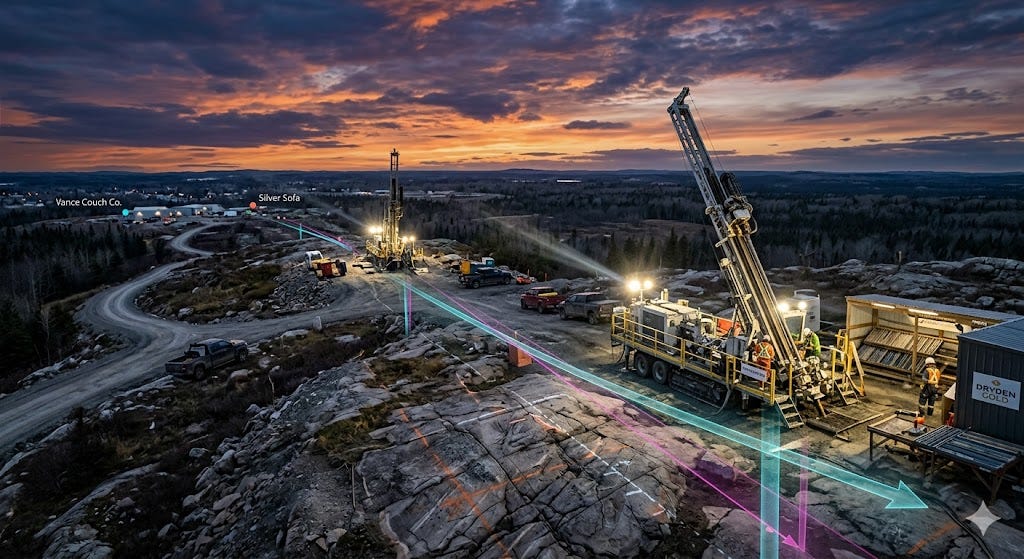
Company Update: Dryden Gold Corp. TSXV: DRY
In April’s initiation, the argument was that Dryden’s market cap was pricing in a single-asset explorer while the asset base had already become two districts. Today’s release is not that story. It is the story that comes after — the quieter, more important one: the geological team now understands the high-grade system well enough to predict where it goes at depth, and they are deploying a second drill rig to prove it.
Jubilee is not the headline. The model is.
The drill results from today’s Jubilee infill program are solid but deliberately narrow in scope. Hole DGR-054 returned 2.92 g/t gold over 14.50 metres, with a pair of high-grade shoots nested inside the broader envelope. Hole DGR-056 returned 2.48 g/t over 12.65 metres. DGR-053 confirmed hanging wall mineralization at 0.73 g/t over 9.58 metres, stacking another structure into the picture.
Those are the numbers. Here is the context the numbers sit inside: this drilling was not designed to expand the resource footprint. It was designed to collect structural data. The stated objective at Jubilee was to test the 150-to-200-metre depth window with the explicit goal of improving prediction of high-grade mineralization below that level.
The outcome is a new three-dimensional geological model built around the D3 deformation event — the structural episode responsible for controlling intersection lineation plunge and, by extension, the location of high-grade gold shoots within the Elora shear system. The model now allows the team to systematically plan approximately 100-metre down-plunge step-out holes on every high-grade zone identified. They are not guessing at the next intercept. They are following a structural vector.
“We are now confident in our ability to vector into the high-grade zones at depth and additional testing can be done with shallow drilling.”
— Maura Kolb, President & P.Geo., Dryden Gold
In junior exploration, the difference between a company that hits high-grade intervals and a company that understands why it hits high-grade intervals is the difference between a drill play and a mine. That sentence carries more information than the drill table.
Deploying a second rig is not a tactical choice.
When a pre-resource junior with a ~$50M market cap decides to run two drill rigs simultaneously, it is worth asking where the capital confidence is coming from and what the decision signals about the geological team’s read on the system.
The answer here is not ambiguous. Dryden exited the April financing round — upsized, with Centerra and Alamos Gold participation — with a fully funded program. The decision to add a rig is therefore not a liquidity stretch. It is a deliberate strategy to pursue two objectives in parallel that cannot be efficiently sequenced on a single-rig schedule.
The strategic logic maps directly to what the April initiation said the company needed to do: prove that Gold Rock is not a series of disconnected high-grade pods but a coherent, scalable system with predictable geometry. One rig can drill depth or breadth. Two rigs can do both.
This is exactly what a company looks like when its geological model has matured enough to justify spending its exploration capital on systematic testing rather than opportunistic discovery holes.
Everything the initiation said would matter still matters.
Readers of the April 22 piece — “Two Districts for the Price of One” — will recognize the structural elements of today’s update. The scorecard, run explicitly:
C$250/m drilling cost. Nothing in today’s release changes this. Two rigs running simultaneously at Gold Rock, with the core facility in Dryden and established road access, does not alter the unit economics. The regional infrastructure advantage is not consumed by higher activity — it scales.
The Centerra + Alamos signal. Two mid-tier Ontario-district producers independently holding strategic positions in Dryden is not a coincidence. The Centerra Investor Rights Agreement — the serial top-up pattern flagged in April’s framework note — remains the single most important non-geological signal in the story.
Two districts, one cost base. The May 12 release is exclusively focused on Gold Rock. Hyndman’s 12-kilometre anomaly corridor on the Wabigoon deformation zone, with its six-for-six maiden hit rate, is sitting in reserve as the second generative engine the market has not yet priced. Summer field programs at Hyndman remain on the calendar.
Framework Note
All intervals in today’s release are drilled core lengths and assay values are reported uncut. The 33.50 g/t and 28.80 g/t hits are from sub-half-metre intervals that could represent localized nugget effects. The structural model’s predictive power only gets validated when down-plunge holes arrive this summer and either confirm shoot continuity or don’t. Today’s release is the intellectual setup for that test — not the test itself.
The needle moves on two pillars.
The April initiation assigned Dryden a Sofa Score of 3.78 / Tier C upper. Two pillars shift modestly on today’s news.
Operational Quality: 3.9 → 4.0. Development of a 3-D structural model sufficient to generate systematic down-plunge step-out targets is a material advance in technical maturity. This is not a company still searching for its system — it is a company that has characterized its system well enough to predict where the high-grade goes.
Catalyst Timeline: 3.7 → 3.9. Two rigs compresses the news cycle meaningfully. A single-rig program at Gold Rock was already generating results on a six-to-eight-week cadence. Two rigs, split between deep structural testing and shallow footprint expansion, should sustain a higher-density release schedule through the summer and into fall.
Sofa Score — Updated May 12, 2026
3.83 / 5.00
Tier Assignment · Tier C upper — speculative anchor, unchanged | Spec Book Weight · ~4%
Operational Quality 4.0↑ 3.9
Financial Architecture 3.6
Valuation vs. Intrinsic 3.7
Management Quality 4.0
Catalyst Timeline 3.9↑ 3.7
Tier Upgrade Trigger — Unchanged from April
A maiden resource estimate at Gold Rock or confirmed bedrock continuity across the Hyndman till anomaly on fall drilling. Neither has occurred. Neither is imminent. The sizing discipline — Tier C at ~4% of the Canadian spec book — holds until one of those catalysts lands.
The only question worth asking.
Everything else about this story — the Centerra signal, the two-district footprint, the cost structure, the team quality — is already in the April framework. Today’s release adds one new element: a specific, falsifiable claim by the geological team that their 3-D model can vector drill holes into high-grade shoots at depth.
That claim will be tested this summer. The down-plunge step-out holes are not a fishing expedition. They are a controlled experiment. If the model calls a high-grade intercept at 300 metres depth and the hole delivers it, the quality of this asset — and the premium it deserves relative to other pre-resource Ontario juniors — moves up substantially and quickly. If the model misses repeatedly, the company re-rates back to “interesting early-stage play” and the thesis resets to Hyndman as the primary driver.
Junior exploration is littered with structural models that were right enough to be compelling and wrong enough to be expensive. The 3-D model at Gold Rock has now been staked publicly. Summer will mark the score.
Until the results arrive, the position sizing from April stands. The story is better than it was three weeks ago. It is not yet the story it will be if the down-plunge program delivers.
Patient holders are where they should be.
The Silver Sofa publishes the author’s personal views. Nothing here constitutes a recommendation to buy, sell, or hold any security. The author holds a position in Dryden Gold Corp. (DRY.V) at the time of publication and may transact in the security at any time without further disclosure. Early-stage mineral exploration carries a high risk of total capital loss. Please conduct your own due diligence and consult a licensed financial advisor before making any investment decision. Read the original initiation — “Two Districts for the Price of One” (April 22, 2026) — for full background on the company, the Sofa Score framework, and the risk disclosures applicable to this position.