The Stability Premium
Chokepoint-free energy, the pivot, and why two of the best macro investors alive are quietly buying the same Western-aligned producer arc.

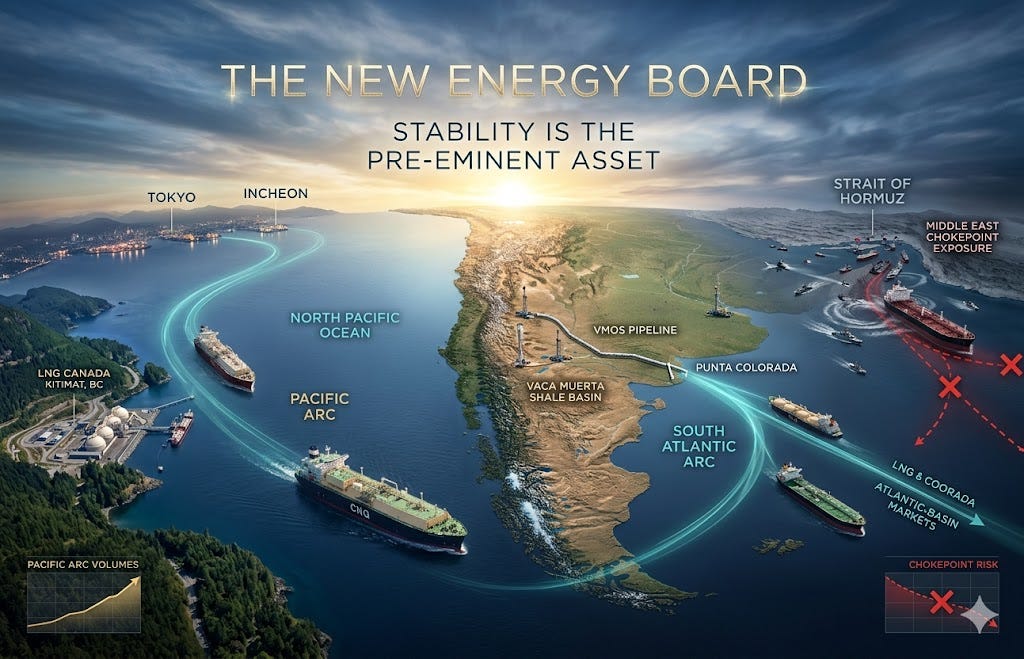
In the first quarter of this year, Stanley Druckenmiller increased his position in a single Argentine state-owned oil company by 433 percent. Howard Marks rotated out of his pure-play Vaca Muerta developer and into the same name. Neither has commented publicly. Their 13Fs did the talking.
They are not betting on geology. Geology has been there for a century. They are betting on something most investors haven’t priced yet: that in a world where the Strait of Hormuz disrupts on a 30-day cycle, where Suez transits get re-routed around the Cape, where Panama runs low on water, and where the Bab-el-Mandeb is contested by people with anti-ship missiles — stability itself is now the scarce commodity in global energy. That isn’t a tagline. It’s a re-pricing event in motion. And it’s the second bifurcation worth owning in this cycle.
Recap from Piece 1: A bifurcation is a structural break in the factor exposure that defines a sector. AI bifurcated last month when the White House halted Claude Mythos, splitting the trade into capability-gated cloud frontier (Path A) and sovereign-by-default edge inference (Path B). Energy is bifurcating now, along a different axis: chokepoint exposure versus chokepoint-free routing. Same framework. Different fork.
Hormuz Was the Regime Change
The conventional read on Hormuz disruption is that it’s episodic. Premia spike, premia decay, things normalize. Buy the dip on Brent if you must, but don’t restructure the book around it.
That read is wrong because it misses the second-order effect. The first-order effect is the price spike, which does eventually decay. The second-order effect is the persistent risk premium that gets built into every long-duration contract written after the disruption — LNG offtake agreements, pipeline tolling deals, refinery feedstock contracts. Once buyers internalize that 30 percent of seaborne oil and 20 percent of global LNG transits one twenty-mile stretch of contested water, their willingness to pay for *alternative* sources of the same molecule resets higher and stays there.
The Asian LNG spot index surged roughly 90 percent in March on the Qatar supply shortfall. European spot prices rose more than 60 percent in the same window. These weren’t speculative spikes — they were forward-curve adjustments to a buyer base re-doing its supply chain math. South Korean and Japanese utilities, German and Italian importers, all woke up in the same month to the realization that the single largest exporter on earth ships through a chokepoint that the IRGC can close with a single press conference.
That re-pricing creates the trade. Sellers who can credibly deliver molecules without touching the Middle East get an embedded premium — the premium for being someplace else. It pays to be geopolitically boring, so who fits that description?
There are not many. There are essentially three Western-aligned export arcs that don’t depend on Middle East chokepoints: the US Gulf Coast (still routes through Suez or Panama for Asian and European deliveries, both of which have their own problems), the Canadian Pacific Coast (no chokepoint, direct Asian routing), and the South Atlantic Coast of Argentina and Brazil (no chokepoint, direct European and Asian routing via the Cape if necessary, but more naturally to Atlantic-basin buyers).
The bifurcation in energy splits along that line. The chokepoint-free names get the stability premium. The chokepoint-exposed names get re-rated lower against them, regardless of how good their underlying asset base is. The market is treating “global LNG exporters” as one trade. They are not one trade. Let me show you the two halves.
What the Framework Retroactively Names
The bifurcation framework didn’t appear out of nowhere. It crystallized out of work I’ve been publishing for the better part of two months, and one of the things the framework does is retroactively name what those earlier pieces were already arguing.
The LNG Decade, published April 26, mapped the post-Hormuz LNG value chain end-to-end and identified the FSRU import-terminal layer as the bottleneck the market wasn’t pricing. The trade names there were Cheniere, Venture Global, EQT, Tourmaline, ARC Resources, Peyto, Pembina, and the central anchor — Excelerate Energy as the regasification pure-play. What I was describing without naming it was the chokepoint-free Western producer arc and its enabling downstream infrastructure. The Canadian upstream cluster I anchored on — Tourmaline, ARC, Peyto feeding LNG Canada and Ksi Lisims — is precisely the Pacific arc this piece reframes around CNQ as the integrated diversified expression. EE is the export-receiving parallel to what I’ll call the producing end of the Atlantic arc. The names were right. The framework was implicit.
The Pirate State Needs Picks and Shovels, published May 4, mapped the enforcement layer underneath everything else. Richard Medhurst’s “Petrogas-Dollar” thesis — the recognition that the United States has transitioned from a country that fights wars for oil into one that uses its existing oil dominance to enforce a global currency and trade system — is the institutional mechanism that makes the stability premium described in this piece a structural re-pricing rather than a transient arbitrage. The SHIPS for America Act, the Maritime Action Plan, the Pentagon’s 2027 procurement bans on Chinese antimony, tungsten, and rare earth magnets — these are not background context. They are the active enforcement machinery of the new energy order. The Pirate State is what makes “Western-aligned” enforceable as an investment category. Without that enforcement, “Canadian molecules to Asian markets” is a preference. With it, it’s a system.
The LNG Decade mapped the supply chain. The Pirate State mapped the machinery that enforces it. The bifurcation framework is the analytical layer that says: this is now the operative factor exposure across global energy equity.
The market is still treating “global LNG exporters” as one trade. They are not one trade. The producers who clear both bars — Western-aligned plus chokepoint-free — are being structurally re-priced higher. The ones who clear neither are being structurally re-priced lower. The ones in between are getting compressed against the spread.
What’s new in this piece, beyond the framework label itself, is the Atlantic-arc completion. The LNG Decade focused on the US Gulf Coast and Canadian Pacific buildout. It did not address what the same factor exposures look like from the South Atlantic. The UAE’s exit from OPEC+ on May 1 and ADNOC’s XRG vehicle financing the ENI–YPF LNG joint venture at Vaca Muerta is the Petrogas-Dollar doctrine playing out in concrete capital allocation: the same money that is leaving the chokepoint-exposed cartel is financing the chokepoint-free alternative. That capital flow is what makes the Argentine angle in this piece — and the Druckenmiller and Marks 13F validation that opens it — the natural completion of the geographic arc the LNG Decade left half-mapped.
The Pacific Arc
What Canada Just Did, While No One Was Watching
For two decades the Canadian LNG export thesis was a punchline. There were paper proposals, environmental reviews that never closed, and First Nations consultations that never resolved. Every quarter, an analyst would write a note saying Canada could be a Pacific LNG superpower if it ever got its act together. Every quarter, nothing happened.
That ended on June 30, 2025, when LNG Canada loaded its first cargo at the Kitimat terminal and shipped it directly into the North Pacific.
The numbers since are not a pilot project. Train 1 came online last June. Train 2 began production in November. Phase 1 is now running at full operational tempo — the facility has shipped more than 60 cargoes, with the majority of volumes flowing to South Korea. Phase 1 capacity is 14 million tonnes per annum. Phase 2 would double that to 28 MTPA, making it the second-largest LNG facility in the world.
The Phase 2 timeline is what most investors haven’t caught up to. The joint venture — Shell at 40 percent, Petronas at 25, PetroChina and Mitsubishi at 15 each, KOGAS at 5 — approved hundreds of millions of dollars in incremental funding on May 1 to finalize work scopes ahead of a year-end FID. Two days ago, on May 15, the governments of Canada and British Columbia signed a joint pact with the JV to close remaining items. Natural Resources Minister Tim Hodgson stated publicly that FID is “likely to go later this year.” Phase 2 has been designated a project of national interest by the federal Major Projects Office, which compresses regulatory timelines structurally.
The chokepoint-free routing isn’t a marketing line. There is no IRGC radio transmission that reaches a tanker leaving Kitimat. There is no Suez, no Bab-el-Mandeb, no Panama. The cargo goes from the North Pacific directly into Tokyo Bay or Incheon. That is the entire trade.
And LNG Canada is not the only project. The Canadian Pacific arc has four other LNG facilities at various stages:
Cedar LNG (3 MTPA) — floating facility near Kitimat, world’s first Indigenous-majority-owned LNG project, powered by BC Hydro renewables, under construction, targeting in-service 2028. Offtake contracts already signed with ARC Resources, Pembina, Petronas, and Ovintiv.
Woodfibre LNG (2.1 MTPA) — near Squamish, electrified design, in-service targeted 2027.
Ksi Lisims LNG (12 MTPA) — floating facility being developed by the Nisga’a Nation, Rockies LNG, and Western LNG, environmental approvals secured September 2025, offtake agreements with Shell and TotalEnergies, designated national interest project, FID expected this year, first production targeted 2029.
Tilbury LNG Phase 2 — smaller-scale expansion by FortisBC.
Add LNG Canada Phase 2, and Canada is on track for roughly 45 MTPA of liquefaction capacity by the early 2030s. That’s roughly six times current capacity. Canada at 45 MTPA would equal more than half of Qatar's pre-disruption base capacity — and Canada is the only top-four exporter that is simultaneously growing rapidly AND chokepoint-free. It would make Canada one of the four largest LNG exporters in the world, alongside the US, Qatar, and Australia — and the only one of those four where the cargoes don’t transit a contested waterway.
The Equity Vehicle: CNQ
If you’re allocating capital to the Pacific arc, the cleanest single-stock expression is Canadian Natural Resources. Here’s why.
The LNG Canada complex is fed by the Coastal GasLink pipeline. Coastal GasLink draws gas from the Montney and Duvernay basins, where CNQ 0.00%↑ is the largest single producer. CNQ has the longest reserve life of any major Canadian integrated, the lowest sustaining capex per barrel in its peer group, a 25-year dividend growth record, and a balance sheet that’s been disciplined through three energy cycles. It is not a pure-play LNG name. It is something more durable — the diversified compounding-machine version of long Canadian molecules into Asian end markets.
You want a Sofa Score:
CNQ · Canadian Natural Resources
Operational Quality — 4.5/5. World’s largest mineable oil sands position, low-decline long-life conventional, integrated heavy oil refining, dominant Montney/Duvernay gas position feeding Coastal GasLink and LNG Canada.
Financial Architecture — 4.5/5. Investment-grade balance sheet, 25 consecutive years of dividend increases, ratable buyback, $55/bbl breakeven free cash flow, disciplined capex.
Valuation — 3.5/5. Re-rating into LNG Canada has begun but is not complete. Trading at a meaningful discount to US large-cap integrated peers despite superior reserve life and lower geopolitical risk.
Management — 4.5/5. One of the best capital allocation reputations in the global E&P universe. The “always-on” buyback framework is exemplary.
Catalysts — 4.5/5. LNG Canada Phase 2 FID by year-end, Trans Mountain Pipeline ramp continues, Cedar LNG in-service 2028, Carney government de-risking of major projects through the MPO.
Composite 4.3/5 → Tier A. Core compounding position with embedded LNG optionality.
For US natural gas exposure to the same Hormuz arb, the planned vehicle is AR 0.00%↑ or EQT 0.00%↑ — both ride the spread between Henry Hub and Asian/European delivered LNG netbacks. AR has the most NGL torque and the highest beta to the trade. EQT has the strongest balance sheet and the cleanest pure-play Marcellus exposure. They are additive to CNQ, not substitutive. CNQ is the diversified Pacific producer. AR or EQT is the US LNG arb torque.
The Atlantic Arc
Why Druckenmiller and Marks Are Both in YPF
Vaca Muerta is the second-largest shale gas basin and fourth-largest shale oil basin in the world. It has been known for thirty years. For most of that time, the Argentine state’s macroeconomic instability made the resource un-investable at any serious institutional scale — currency controls, retroactive royalty hikes, the Repsol expropriation in 2012, three sovereign defaults since the turn of the century. The geology was always there. The country wasn’t. The country, now, is. That’s the trade.
Three things have happened in roughly fifteen months that re-rate the Argentine energy thesis from frontier to investable:
RIGI. The Régimen de Incentivo para Grandes Inversiones, signed into law under the Milei government’s Basic Law package. For qualifying projects above $200 million in investment: corporate tax dropped from 35 to 25 percent, full exemption from export duties, VAT crediting from the pre-operational stage, 30-year regulatory stability, and — critically — access to international arbitration for dispute resolution. That last clause is the structural one. It means a future government cannot unilaterally rewrite terms without facing ICSID. The framework was extended by executive action to July 2027, which gives the current administration a full window to lock in major project filings before the October 2027 presidential election.
The VMOS pipeline. 437 kilometers, 30-inch diameter, from Allen to Punta Colorada on the Atlantic coast of Río Negro. Currently 62 percent complete. First oil expected January 2027 at 180,000 barrels per day, ramping to 550,000 barrels per day in the second half of 2027, expandable to over 700,000. YPF holds the largest stake at 30 percent and recently increased its shipping capacity to 164,000 barrels per day. Partners include Vista, Pampa, Pan American, Chevron, Shell, Pluspetrol, and Tecpetrol. This is the largest oil transportation project in Argentina in two decades, and it gets the country off the chokepoint-dependent map for crude exports.
The LLL LNG project. YPF filed its formal RIGI submission this week for the largest project ever submitted under the framework: 1,152 wells across five Vaca Muerta blocks targeting 240,000 barrels per day of dedicated production by 2032, alongside the joint LNG infrastructure with ENI and XRG (ADNOC’s international investment vehicle). First LNG cargoes targeted for 2030–2031.
The ENI-YPF-XRG partnership is the part that connects this back to the meta-thesis. XRG is ADNOC’s international vehicle. On May 1 of this year, the UAE formally exited OPEC+. That is the same country — through different financial vehicles — exiting the Middle East producer cartel while simultaneously financing the Atlantic-basin alternative. That is not a coincidence. It is a coherent geopolitical bet by capital that has access to better information than most Substack readers and most CIOs.
Stanley Druckenmiller and Howard Marks reading the same set of facts and arriving at the same trade is the validation kicker. Both filed Q1 13Fs disclosing material YPF positions. Druckenmiller’s position increased by 433 percent quarter-over-quarter and now represents 5.12 percent of his disclosed portfolio — that is not a trial position. Marks rotated out of Vista (the pure-play Vaca Muerta developer he had previously held) into YPF specifically — a deliberate choice in favor of the state-blessed integrated, with RIGI access, over the pure-play developer.
What does YPF actually look like as a security?
YPF · YPF Sociedad Anónima
Operational Quality — 4.5/5. $8.80/boe lifting cost (top decile globally), 205,000 bopd shale production up 39 percent year-over-year, the lowest-cost Vaca Muerta operator at scale.
Financial Architecture — 3.5/5. Net leverage 1.57x and improving, $871M Q1 FCF, capital plan stress-tested to $55/bbl per management. Non-core divestitures (Metrogas and others) generating over $1B. Capped at this score by the 51 percent state ownership — principal-agent risk is structural and persistent.
Valuation — 4.0/5. Trading at roughly 4.3x forward EV/EBITDA versus peer integrated majors at 5–6x. The discount is Argentina risk. The question is how much of it narrows under RIGI plus the VMOS cash flow ramp.
Management — 3.0/5. CEO Marín is operationally credible and reform-aligned, but the company remains a 51-percent state-owned entity. Cash flow allocation, capex pacing, and dividend policy run through political priorities. This score is capped.
Catalysts — 4.5/5. VMOS first oil January 2027 (medium-cycle), LLL RIGI approval and ENI/XRG LNG FID mid-2026 (long-cycle), UAE OPEC+ fracture continuing to unfold, October 2027 Argentine election as the binary risk catalyst.
Composite 3.9/5 → Tier B+. Real conviction territory. Sizing must reflect the political binary.
The Argentine Binary — Said Plainly
I’m not going to soft-pedal this. Argentina has defaulted three times this century. It expropriated YPF from Repsol in 2012, with the current Argentine state stake originating from that expropriation. It has imposed currency controls multiple times in living memory. The country discount on Argentine equity exists for reasons that are not abstract.
The 2027 election is the binary risk. If a Peronist government returns, every RIGI-era assumption is testable. The international arbitration backstop is meaningful — it means the recovery path runs through ICSID and Western courts rather than through unilateral expropriation — but it does not mean the cash flow profile survives intact. A 30-year stability clause and a willing-to-honor-it government are not the same thing.
This argues for two things. First, YPF is not a retirement-account position. It belongs in a speculative or taxable book where the binary downside doesn’t impair long-duration compounding capital. Second, sizing matters. At 2 to 2.5 percent in a speculative sleeve, the asymmetric upside is meaningful (a re-rating to peer multiples implies 40 to 70 percent upside before the LNG cash flow even shows up) and the downside is bounded at a manageable book impact even on a Peronist tail. That’s just how we are playing it, you do you.
The shape of the trade: own it where it belongs, size it where it fits, and let the catalyst stack do the work.
The “New Energy Board”
Step back from the two case studies and look at the meta-thesis.
The world is reorganizing its energy supply around two characteristics that didn’t matter much in the prior cycle: jurisdictional Western alignment, and chokepoint-free routing. The producers who clear both bars get a structural premium. The producers who clear neither get a structural discount. And the producers in the middle — US Gulf Coast LNG, for example, which is Western-aligned but chokepoint-exposed for Asian deliveries — get something in between.
Canada plus Argentina plus Guyana and Brazil. Each member offers something the chokepoint-exposed producers can no longer credibly offer: delivery without a phone call to Tehran or Washington determining whether the cargo gets through. Chances are, states who may still buy a majority of LNG from the US, will hedge their bets by having contracts and sourcing from Canada, or Argentina. International trust in the USA is at an all time low. It’s risky for allies to put too much stock in stable supplies from an unstable administration.
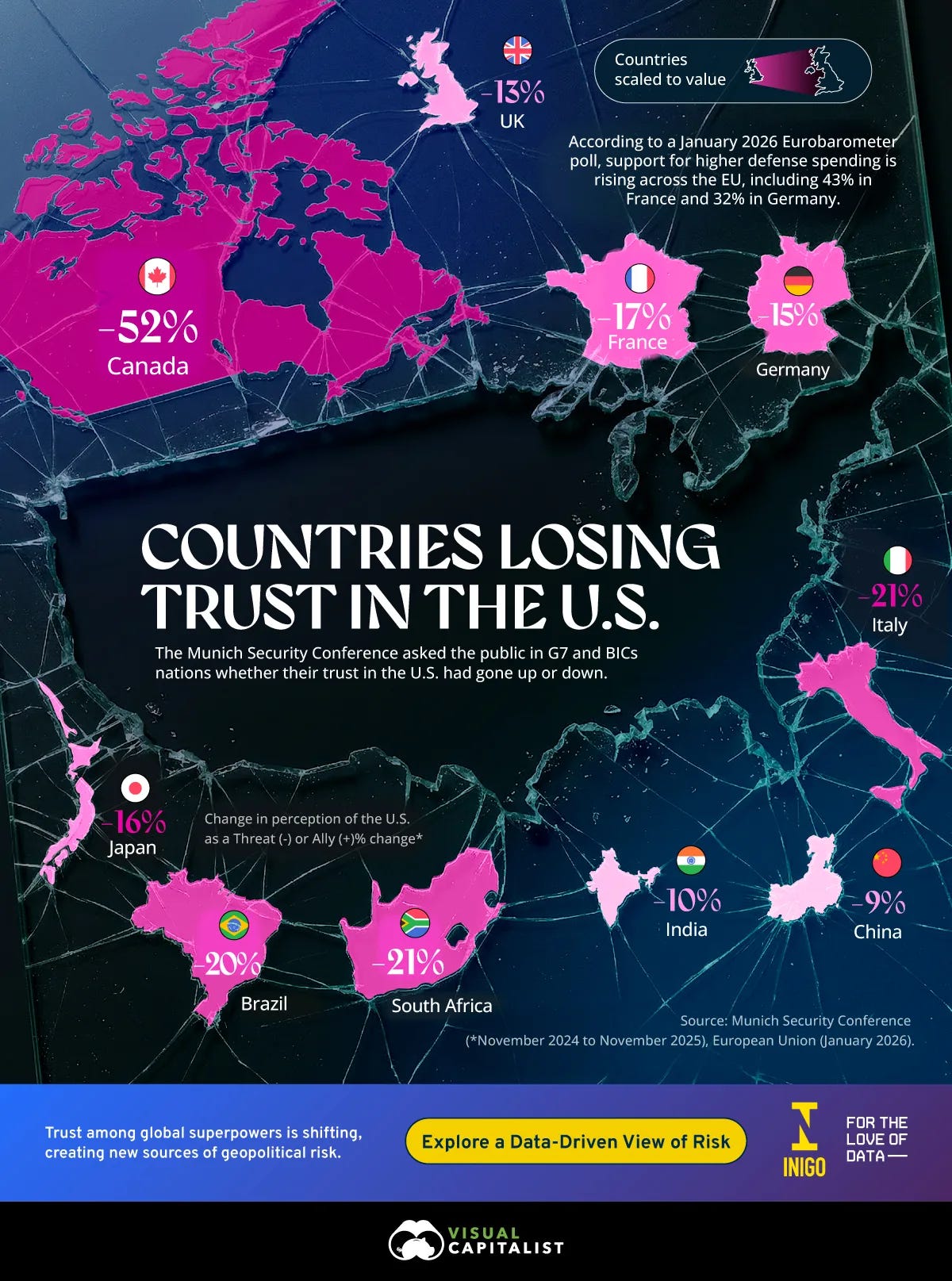
This is the same meta-thesis as Piece 1, applied to a different sector. In AI, the bifurcation runs along capability-gating exposure. In energy, it runs along chokepoint exposure. Both reduce to the same insight: trust is the new scarce commodity, and assets that can be delivered without depending on the goodwill of an adversary get re-priced higher than assets that can’t.
In edge AI, that means sovereign-by-default inference on devices you own. In energy, it means molecules from jurisdictions you trust, shipping through routes nobody can close. The framework holds and the trade is the split.
The Trade
Across the full bifurcation, the energy book lines up like this:
Core Pacific arc — CNQ. Tier A. Suitable for retirement accounts. Diversified compounder with embedded LNG Canada optionality. The cleanest single-stock expression of the chokepoint-free Pacific thesis.
Near-term US LNG arb torque — AR (preferred) or EQT. Pure-play Marcellus / Appalachian gas. AR has the higher NGL torque and is the cleanest expression of the Asian petrochemical demand premium. EQT has the cleaner balance sheet. Suitable for retirement accounts. Initiate at 2.5 to 3 percent. This is the cash-flow-this-quarter expression. CNQ is the cash-flow-five-years expression.
Atlantic arc — YPF. Tier B+, but with material upside asymmetry. Belongs in speculative or taxable accounts, not retirement capital. Size to 2 to 2.5 percent. The 13F validation from Druckenmiller and Marks is real signal. The Argentine binary is real risk. Both are priced into a 4.3x EV/EBITDA multiple.
Downstream LNG infrastructure exposure. Worth mentioning but not the focus of this piece. Companies like Expend Energy EE 0.00%↑ Pembina (CDN: PPL) and TC Energy TRP 0.00%↑ which own the pipeline infrastructure that feeds the Canadian Pacific arc, get the same stability premium with a different risk-return profile.
Underweight or exit: chokepoint-exposed pure-plays without offsetting structural advantages. Any producer whose entire export thesis depends on Hormuz, Bab-el-Mandeb, or Suez transit is on the wrong side of the bifurcation. The asset quality may be excellent. The route to market is now the binding constraint.
The Counterargument
Two real arguments against this framework. I’m not going to give them more space than they deserve, but they have to be on the table.
Hormuz disruption is transient. Iran de-escalates, the IRGC stands down, the strait stays open, Brent backs off, and the embedded premium decays out of the long-duration LNG contracts. The Canadian and Argentine alternatives still get built, but the urgency premium fades.
I’m partially sympathetic to this, but only partially. The Phase 1 cargoes have shipped. The Phase 2 funding has been committed. The VMOS pipeline is 62 percent complete. The LLL filing is in. The capital has already been allocated, the offtake contracts are being signed, and the buyer base has already done the math on supply chain risk. Even if Hormuz never gets disrupted again for a decade, the buyer-side demand for chokepoint-free alternatives has already been booked. The trade doesn’t depend on Hormuz being disrupted again. It depends on Hormuz having been disrupted at all.
Argentine political risk is binary and severe. A Peronist government in October 2027 changes everything. RIGI gets tested. The international arbitration framework is robust on paper but slow in practice. Multi-year ICSID cases don’t help quarterly earnings.
This one is genuinely real, and it’s why the sizing recommendation is 2 to 2.5 percent of a spec book and zero in retirement accounts. The asymmetric upside justifies the position. The political downside justifies the sizing discipline. Don’t conflate them.
The Stability Premium
For thirty years, global energy markets assumed that supply was fungible. A barrel from Saudi Arabia was substantively equivalent to a barrel from Texas or Alberta or Vaca Muerta. They cleared at roughly the same price. The discounts that did exist — Brent versus WTI versus WCS — were quality-driven and routing-driven, but the underlying assumption was that any of these molecules would reach any of these end markets at predictable cost. That assumption is no longer operative.
What Hormuz disruption did — combined with the Red Sea reroutes, the Panama drought, the sanctions architecture around Russia, and the broader recognition that geopolitical chokepoints can close on short notice — is teach the buyer base that molecules are not fungible anymore. A barrel that ships from a port nobody can close is worth more, structurally, than a barrel that ships from a port that requires the cooperation of three or four geopolitical actors.
The stability premium isn’t a one-time arbitrage. It’s a re-pricing of an attribute that didn’t have a price before.
That re-pricing is in motion. It is partially visible in spot LNG prices. It is partially visible in the willingness of major Asian utilities to sign 20-year offtake contracts with Canadian producers at premium pricing. It is partially visible in the 13Fs of Stanley Druckenmiller and Howard Marks. It is not yet fully visible in equity multiples.
The multiples will follow. They always do. The question is whether you own the right names before they do. Long Canada. Long the Atlantic-basin alternative, sized for the binary. Underweight the chokepoint-exposed pure-plays whose only differentiation is geological. Stability is the trade.
What Comes Next
Piece 3 — “The Cost Curve Reprise”
Mining bifurcates along input-cost position. The sulphuric acid story, the diesel inflation story, and the Hormuz sulphur disruption combine to split the producer cohort into high-grade winners and low-grade losers. Some of you read this thesis when I published The Cost Curve Comes for the Heap in March. The framework version makes it sharper. The same meta-thesis that splits AI by capability-gating exposure and splits energy by chokepoint exposure also splits mining by input-cost exposure. Three sectors. One pattern. Closing the trilogy with the case study that started it.
The split is the trade. The stability premium is the second one to size. The cost curve is the third.
Disclosures: Long CNQ, EE at time of publication. Considering AR and YPF. The author and clients of associated accounts may hold or initiate positions in any of the securities discussed. Not investment advice. Sofa Score methodology proprietary to the author. Comments, pushback, and counter-trades welcome.